
The register checkbox: one tick, two documents, a court in Yuhang District
Before Hipobuy creates an account it asks you to tick one box. Here is what that box names, what the two documents say about who runs the service and where disputes go, and the line in the agreement that disagrees with the returns policy.
One checkbox, two linked documents
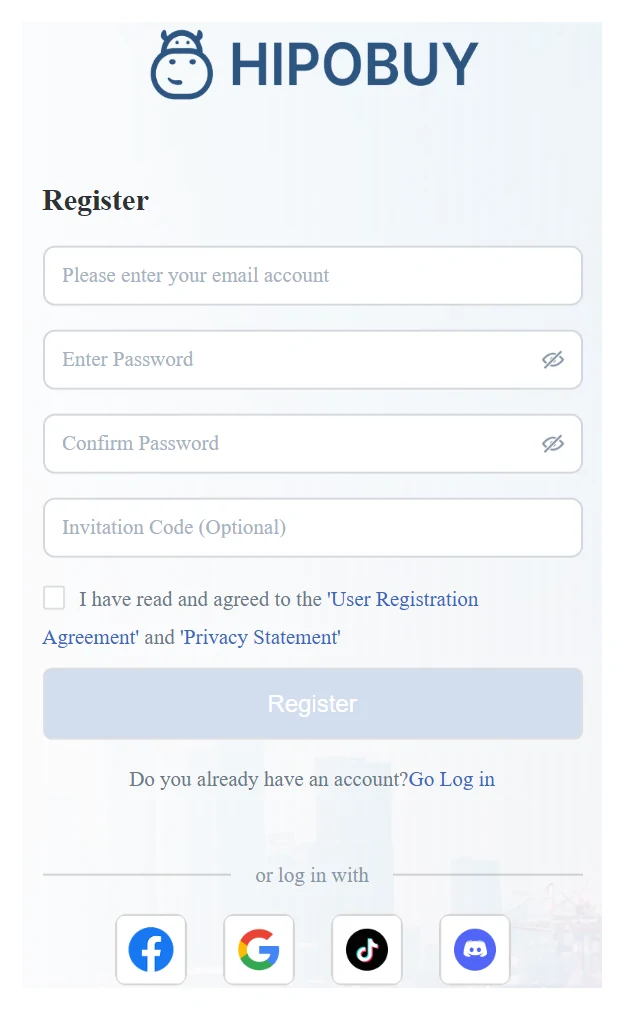
The register page asks for an email address, a password typed twice and an optional invitation code. Under those fields sits one checkbox, unticked, with this wording: I have read and agreed to the ‘User Registration Agreement’ and ‘Privacy Statement’. In our capture the Register button is pale while the fields are empty and the box is unticked. Four social sign-in buttons (Facebook, Google, TikTok, Discord) sit below it.
In the page markup we captured on 16 October 2026, only one of the two names is a hyperlink: “Privacy Statement” opens the statement in a new page, while “User Registration Agreement” is marked up as plain text. The agreement is still easy to find: it is in the site footer, and Hipobuy’s help-centre data tags it, together with the Privacy Statement, to the register page (CFG_PAGE_REGISTER). Two more copies sit in the help centre, word for word the same; we quote the one the register page is tagged to, notice 1772892211576897537.
Ticking the box is the only act of agreement on this page. The agreement itself spells out the effect: finishing registration with the box ticked is taken as proof that you read, understood and accepted every term in it. Nobody checks that you opened the documents. If you want to read before ticking, open both in another window first; the rest of this page tells you where to look.
Inside the Registration Agreement: three agreements in one
The Registration Agreement opens with a notice in square brackets. It asks you to read it before clicking Agree, flags three parts in particular (exemptions or limits of liability, applicable law and jurisdiction, and business rules) and then explains that the “Hipobuy User Registration Agreement” is really three documents: a Hipobuy Service Agreement, Hipobuy Service Terms and a Hipobuy User Privacy Policy.
Two details in that opening matter later. Disputes about the platform’s services are to be settled under the Hipobuy Service Agreement, which is the first part of the same document, not the separate Service Terms you meet at checkout. And the Privacy Policy it bundles is not the Privacy Statement named on the checkbox: they are two different articles in the help centre, with different wording.

Who the Registration Agreement says runs the service
Clause 1 of the Service Agreement part says the electronic services are owned and operated by Hipobuy, then adds that all rights and operations of the registered-user services belong to “Beijing Huanpeng Technology Co., Ltd.”, with a registered address in Daxing District, Beijing. The help-centre Privacy Policy repeats that sentence.
That company is not among the five operators in Hipobuy’s footer, which lists companies in Hong Kong, the United Kingdom, the British Virgin Islands and Poland. Two other documents name the operator differently again: the help-centre copy of the Service Terms gives the ownership and operation rights to “Hipobuy Inc.”, and the order-page Service Terms speak of jointly operating entities, printing a list at the end that matches the footer while section 1 of the same document carries a different list.
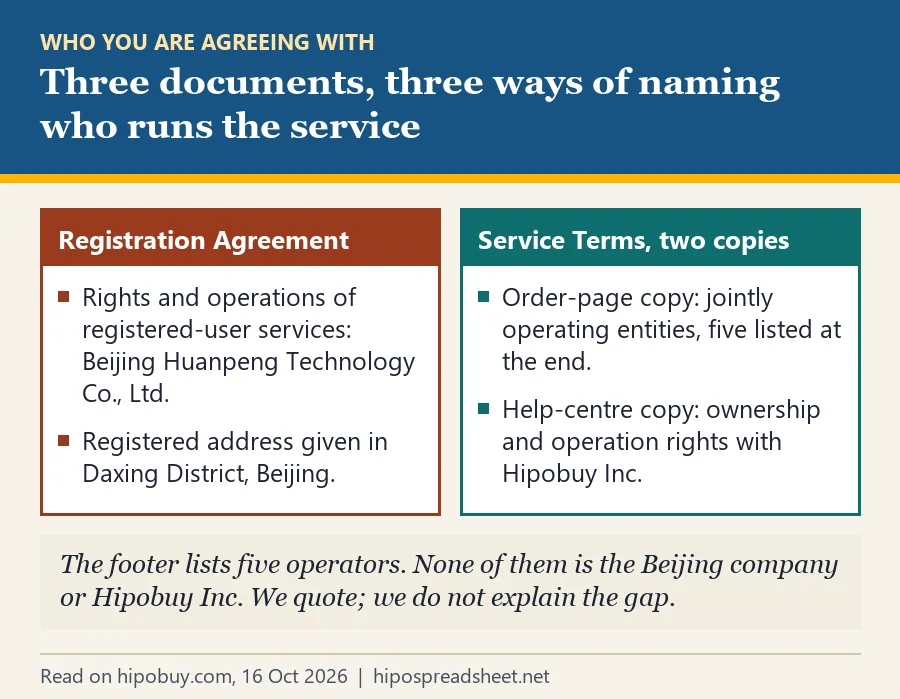
We do not know how these names relate, and Hipobuy does not explain it on any page we read. We only report what each document says. If the identity of the party matters to you, for example before a large order, ask Hipobuy customer service in writing which company you contract with.
Chinese law and a court in Yuhang District
The law clause comes at the very end, under “Governing Law and Dispute Resolution”. It covers the formation, performance, interpretation and dispute resolution of the agreement, and puts all four under the laws of China. Disputes go first to amicable negotiation; if that fails, to the competent people’s court in the place where the agreement was signed. The clause then names that place itself: Yuhang District, Hangzhou, Zhejiang Province.
You sign by ticking a box in your own country, so the signing place is a choice the document makes for you. It is also the third forum you will meet on this site, after the Hong Kong SAR law of the Service Terms and before the Hangzhou arbitration of the parcel agreement; all of them are compared on law and forums.

The 30-day line and the five-day returns article
One sentence in the Registration Agreement contradicts the returns policy you agree to at checkout. Its return and exchange paragraph promises a five-day return and exchange service “(depending on the situation)”, then says only one return or exchange is allowed within 30 days, with no fees, and that later ones may cost money or be refused.
The returns article linked from the order page says something else: five days, equal to 120 hours, counted from the hour after the item reaches the Warehoused status; the seller must agree; and if you simply changed your mind you pay the return shipping, the original domestic shipping and a 5 RMB service fee. The facts file used across this lane treats the returns article as the rule that governs, because it is the dedicated policy and the one repeated in four identical copies. We print the registration line so you are not surprised by it, not so you can rely on it.

The Privacy Statement: a Hong Kong ordinance and the GDPR in one document
The other document on the checkbox is the Privacy Statement, notice 1743203728339603458, which is also linked from every page footer. It contains no governing-law clause. Instead it leans on two data laws at once. Near the top, it says the operating entities jointly decide the purposes and means of processing and act as joint data controllers under applicable data protection laws, “including the GDPR”. Near the bottom, in a paragraph headed Privacy Compliance Statement, it commits to protecting personal data under Hong Kong’s Personal Data (Privacy) Ordinance, Cap. 486.
It is also the most specific of Hipobuy’s documents about tracking. It names Microsoft Clarity and Microsoft Advertising for behaviour metrics, heatmaps and session replays, and describes advertising identifiers used to see which marketing channels bring users in. Like the Service Terms, it opens with its own list of operating entities, and that list does not match the footer.

How long the Privacy Statement says your data is kept
Section 3 of the Privacy Statement answers how long data is kept in one line: once you register, Hipobuy will retain your personal information permanently, and you contact customer service if you want an account or data deleted. The next sentence then recalls the GDPR duty to return or delete personal data when the service or contract ends, unless the law requires it to be kept.
The Service Terms add a route of their own: section 4 says you may ask online customer service to cancel your account, after which Hipobuy stops providing services and deletes or anonymises your data under applicable law. If deletion matters to you, ask in writing and keep the reply.
