Four buttons, four forums: what each Hipobuy document names for disputes
Each Hipobuy document with a law clause, in the order you meet its button, quoted as printed. We list what the documents say and leave the legal question, which one would apply to you, to a lawyer.
Four buttons, four forums, in the order you meet them
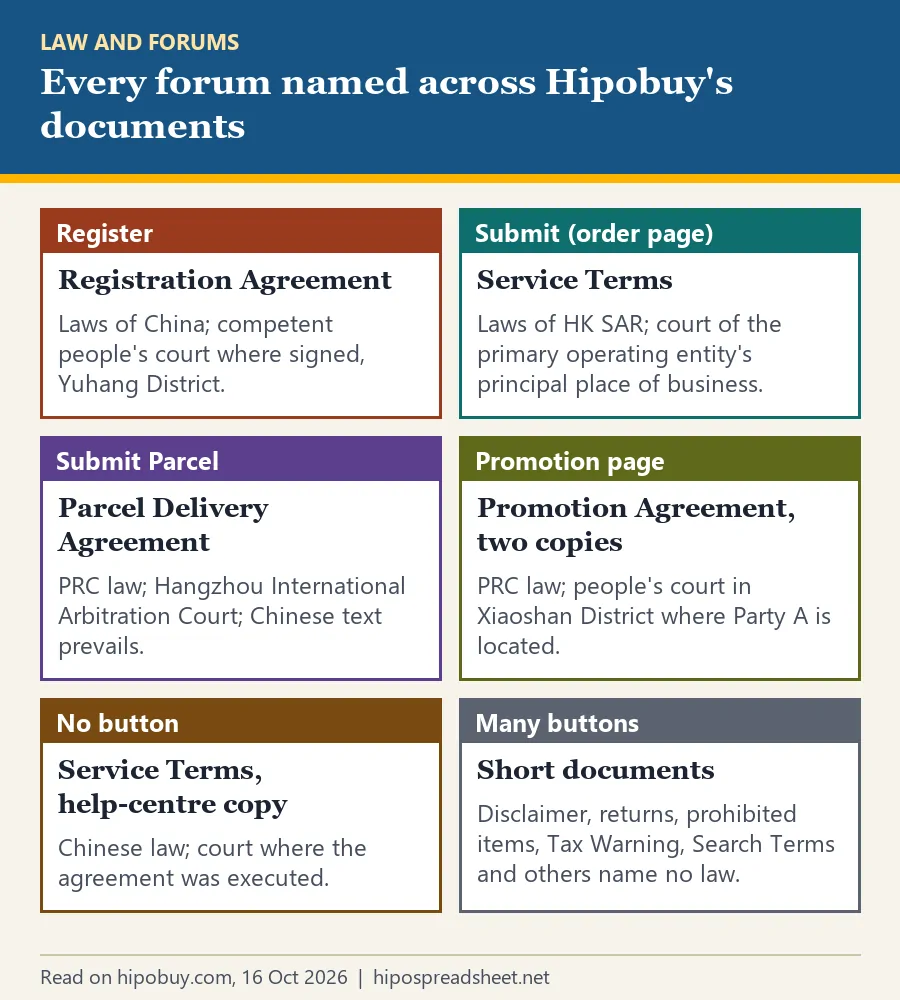
Read in the order a new buyer meets them, Hipobuy’s documents name a different forum at almost every step. Register brings the User Registration Agreement: laws of China, a people’s court in Yuhang District. Submit on the order page brings the Service Terms: Hong Kong SAR law, the court where the primary operating entity has its principal place of business. Submit Parcel brings the International Parcel Delivery Agreement: PRC law, arbitration in Hangzhou. The promotion page brings the Promotion Agreement: PRC law, a people’s court in Xiaoshan District.
A fifth clause sits in a document no button shows, the help-centre copy of the Service Terms, which names Chinese law and the court where the agreement was executed. And many short documents behind the same buttons, from the Disclaimer to the Tax Warning, name no law at all.
Every one of these clauses starts with negotiation; none mentions courts in the buyer’s country.
Service Terms: Hong Kong SAR law, negotiation first
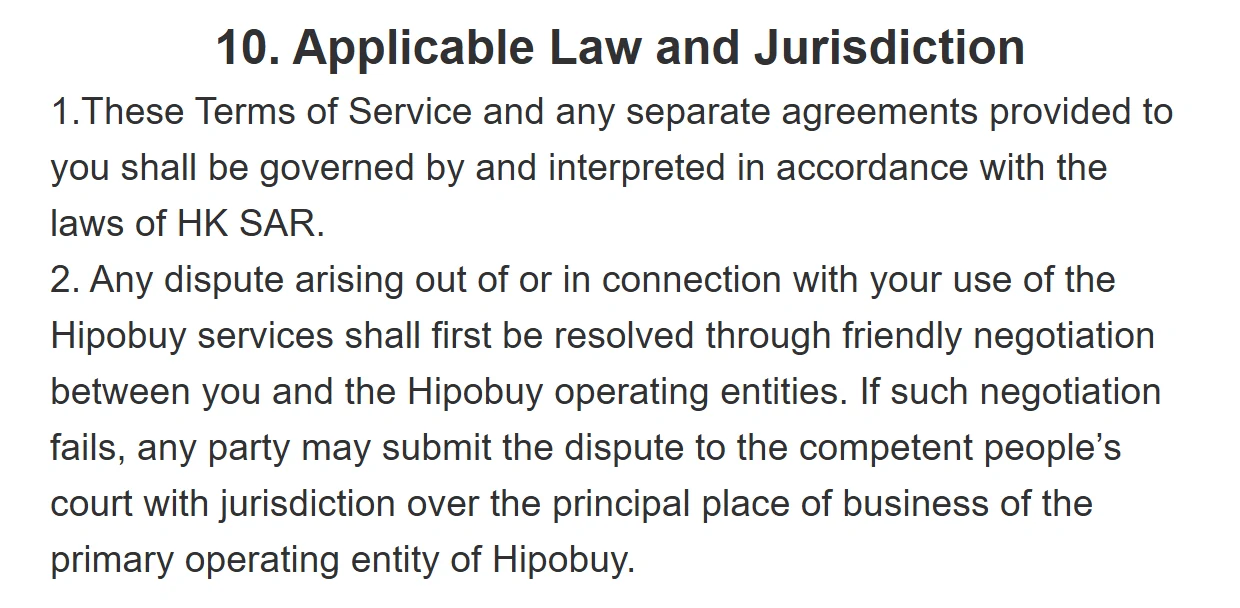
Section 10 of the Service Terms, the document behind the order page and the footer link, has two sentences. The first: the terms and any separate agreements provided to you are governed by and interpreted in accordance with the laws of HK SAR. The second: disputes are first resolved through friendly negotiation between you and the Hipobuy operating entities; if that fails, any party may go to the competent people’s court with jurisdiction over the principal place of business of Hipobuy’s primary operating entity.
Two things are left open by the wording. “Any separate agreements provided to you” could be read to reach the other documents, which name other laws themselves. And the primary operating entity is not named; the list printed under the clause has five companies in four jurisdictions. We note both and resolve neither.
Registration Agreement: the laws of China and a court in Yuhang District
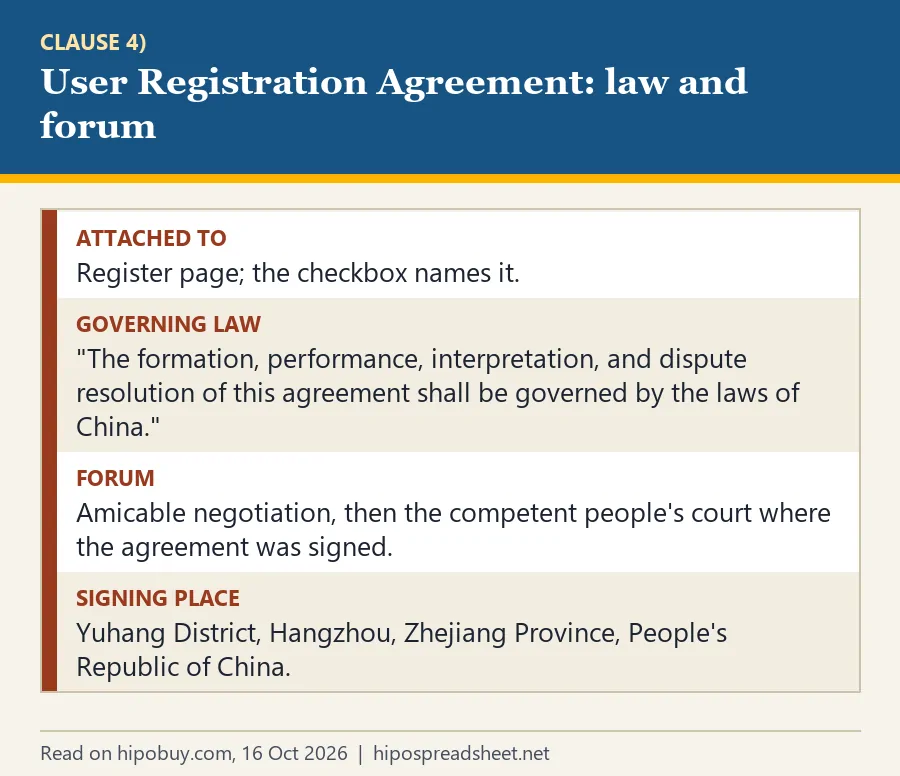
The User Registration Agreement puts “the formation, performance, interpretation, and dispute resolution” of the agreement under the laws of China. Disputes go to amicable negotiation, then to the competent people’s court in the place where the agreement was signed, which the clause fixes as Yuhang District, Hangzhou, Zhejiang Province.
This is the clause you meet first, on the register page, and the one that covers the account itself. Its scope is the agreement, which by its own account bundles a service agreement, service terms and a privacy policy.
Parcel Delivery Agreement: arbitration instead of a court
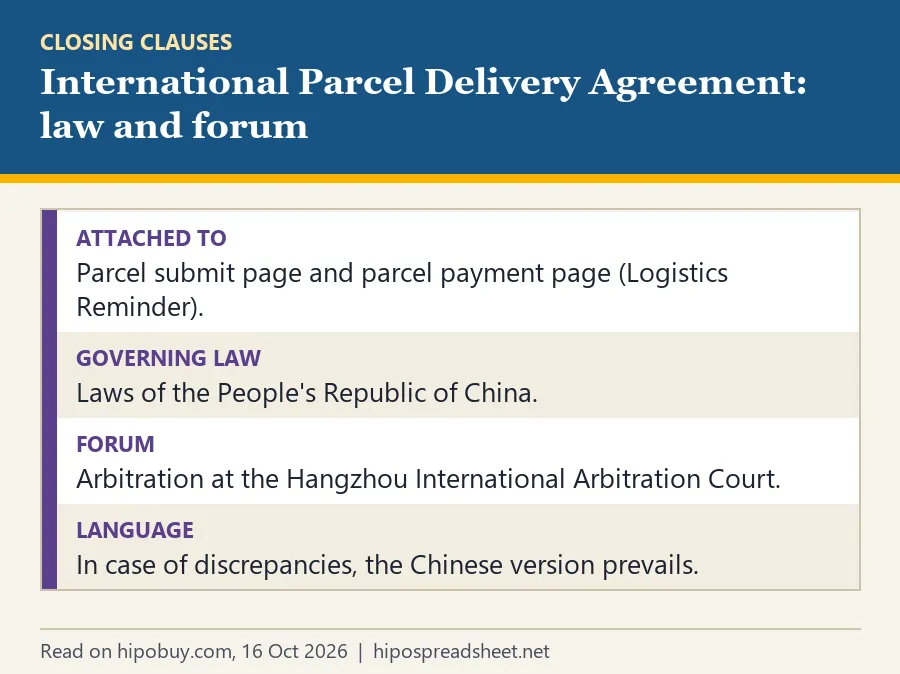
The International Parcel Delivery Agreement is the only document that picks arbitration: disputes go to the Hangzhou International Arbitration Court, under the laws of the People’s Republic of China. It is also the only one that ranks its languages, with the Chinese version prevailing where versions differ.
It covers the part of the service where most things go wrong in practice: loss, damage, delay, customs, declared values. Arbitration usually means a private hearing under the arbitration body’s own rules rather than a public court; the agreement says nothing more about costs or procedure.
Promotion Agreement: a people’s court in Xiaoshan District
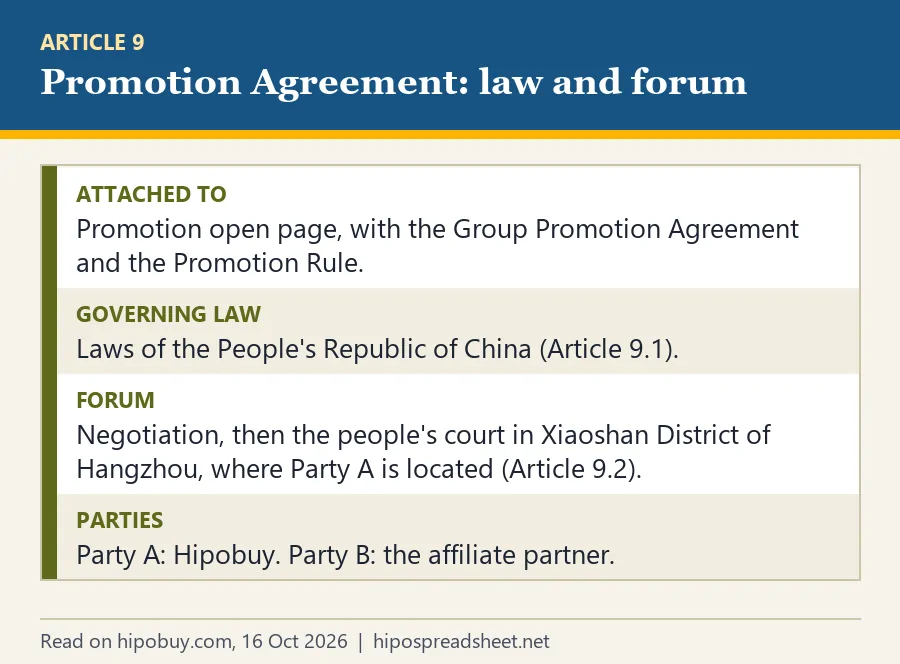
Article 9 of the Promotion Agreement, and of its twin the Group Promotion Agreement, places the agreement under PRC law, and says that if negotiation fails either party may sue in the people’s court in Xiaoshan District of Hangzhou, described as where Party A, Hipobuy, is located. Only people who open the promotion page meet this clause.
Both promotion agreements carry the clause, because their text is the same, word for word. The Promotion Rule tagged to the same page has no law clause of its own, so the rates and conditions it sets sit under whichever clause a court or the parties decide applies to the programme.
The agreement as a whole is on promotion page terms.
The help-centre copy of the Service Terms names Chinese law
The help centre’s FAQ section holds a second copy of the Service Terms, notice 1775431474751275010, under a slightly different title, Service Terms and User Management. No page is tagged to it. Its law clause, numbered 9, says the service agreements and any separate agreements are governed by Chinese law, and that disputes go, after negotiation, to a court of competent jurisdiction where the agreement was executed.
It differs from the order-page copy in two other ways. It gives ownership and operation rights to “Hipobuy Inc.”, and it has no anti-counterfeiting section. The lane’s facts file treats the order-page copy as the one that governs, because it is the one the order page and the footer link to and it matches the Hong Kong operating companies; we show the FAQ copy so that a reader who finds it is not misled.

Documents that name no law at all
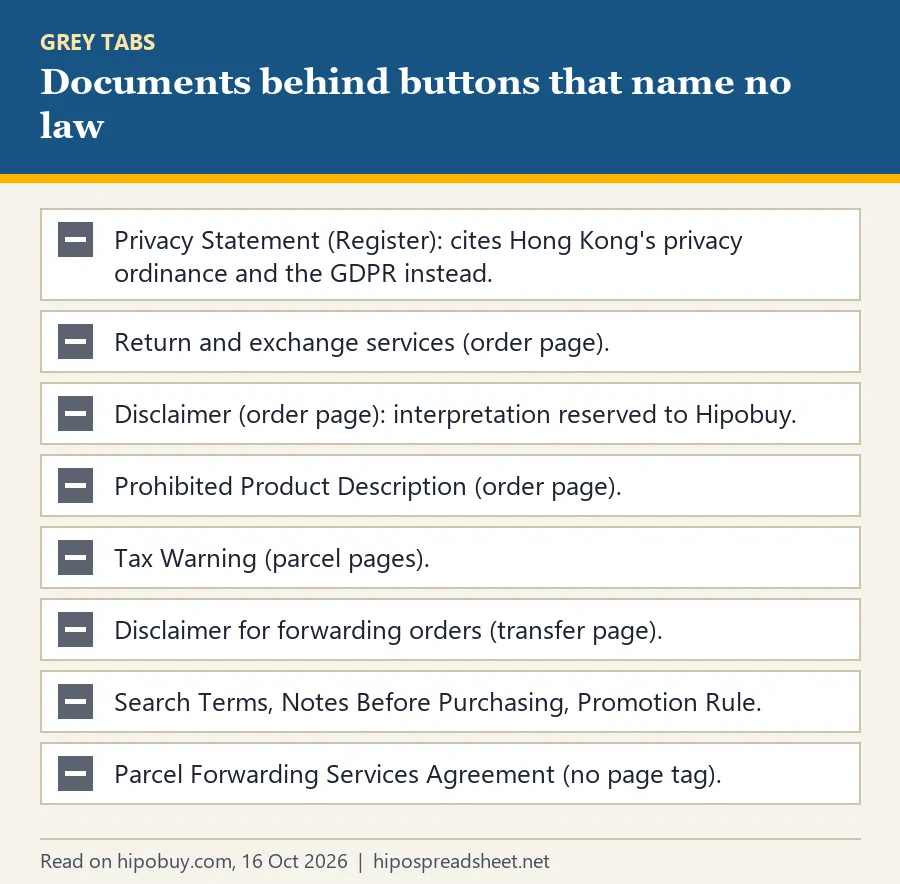
Most documents behind Hipobuy’s buttons have no law or forum clause: the Privacy Statement on the register page, all three non-terms documents on the order page, the Tax Warning on the parcel pages, the forwarding Disclaimer, the Search Terms, both copies of Notes Before Purchasing, the Promotion Rule and the Parcel Forwarding Services Agreement.
The Disclaimer does keep something back: the right of interpretation belongs to Hipobuy. Whether a document without a law clause falls under the Service Terms’ “separate agreements” is exactly the kind of question this page does not answer.
What this page does not decide
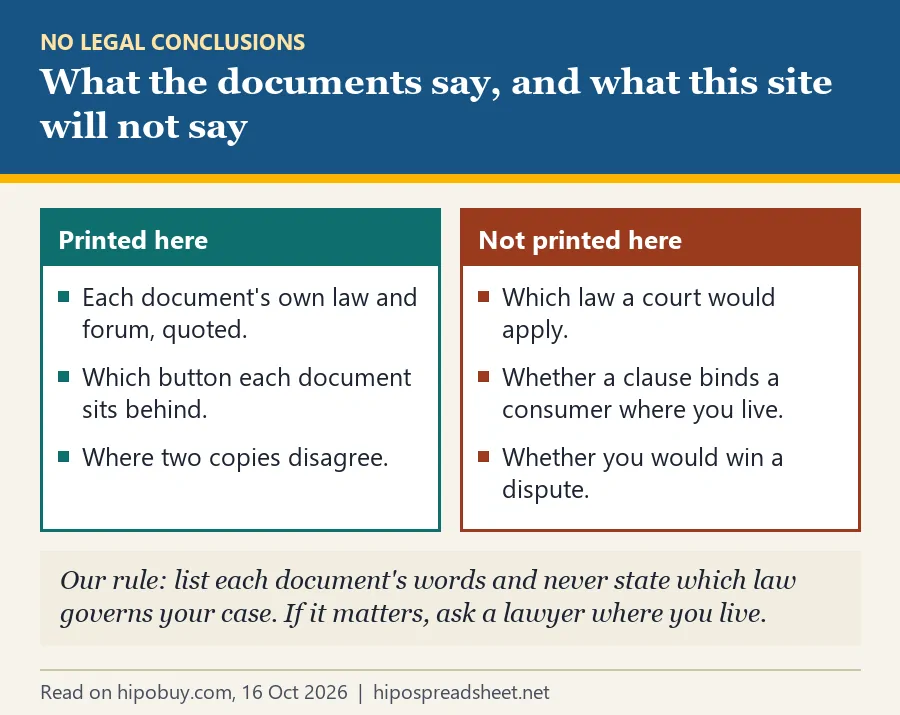
Our rule on this page is simple: we print what each document says and where it sits, and we never state which law governs your case. Choice-of-law and forum clauses in consumer contracts are treated differently from country to country, and some places limit how far such a clause binds a consumer at all. Whether any of these clauses would hold against you, or whether you would win a dispute, depends on facts we do not have.
If a dispute is real and the amount matters, take the notice numbers on this page, the dates we read them and your order records to a lawyer or a consumer adviser where you live. If you only want to know what you clicked, the click map answers that in a minute.