
The promotion page: two identical agreements, one rule sheet, a court in Xiaoshan
Opening Hipobuy’s promotion page puts three documents in front of you. This page reads them as a contract, not as an offer: who the parties are, how a bonus is counted, tax, ending the arrangement and the law clause.
Three documents behind the promotion page
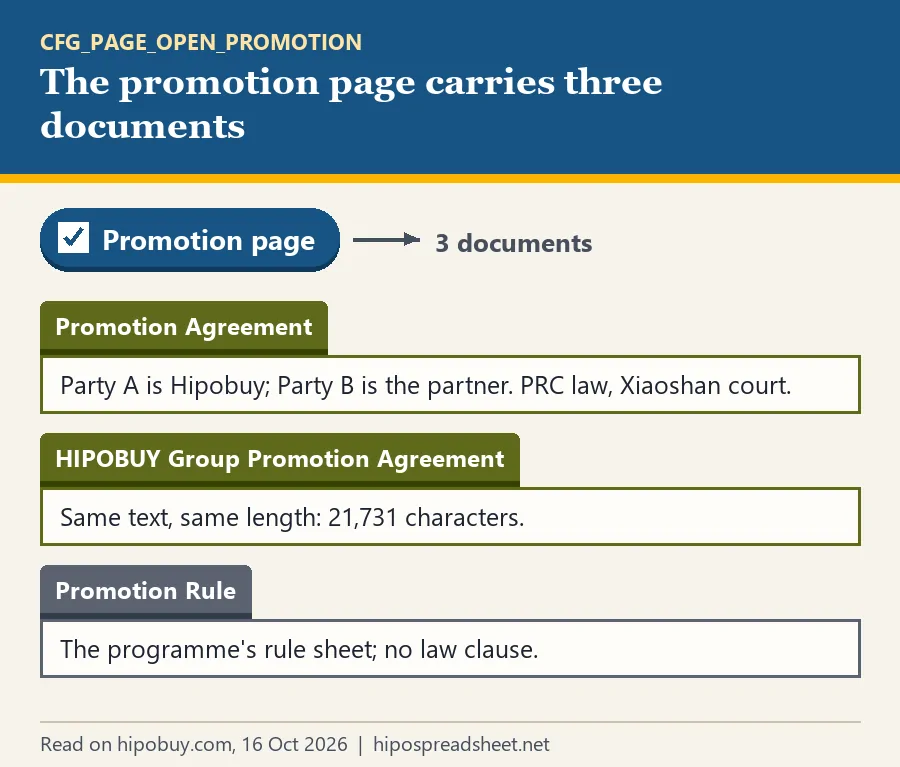
Hipobuy’s help-centre data tags three documents to the page where the affiliate programme opens (CFG_PAGE_OPEN_PROMOTION): the Promotion Agreement, notice 1772917787712880641; the HIPOBUY Group Promotion Agreement, notice 1789138682025971714; and the Promotion Rule, notice 1772882036891648002. The first two have different titles and different notice numbers, but their text is identical, word for word, at 21,731 characters. Two more copies sit in the help centre under the name Affiliate Promotion Service Agreement.
The Promotion Rule is the working sheet of the programme. It carries the rates and conditions, which change with notices, and it has no law clause. We do not reprint rates. This page is not a recommendation to join: it is there so that anyone who does knows what the agreement asks of them.
Party A, Party B and how a bonus is counted
The agreement is between Party A, Hipobuy together with its websites, and Party B, the partner who promotes it. The partner is asked to read the whole text, the bold passages above all, before starting any promotion.
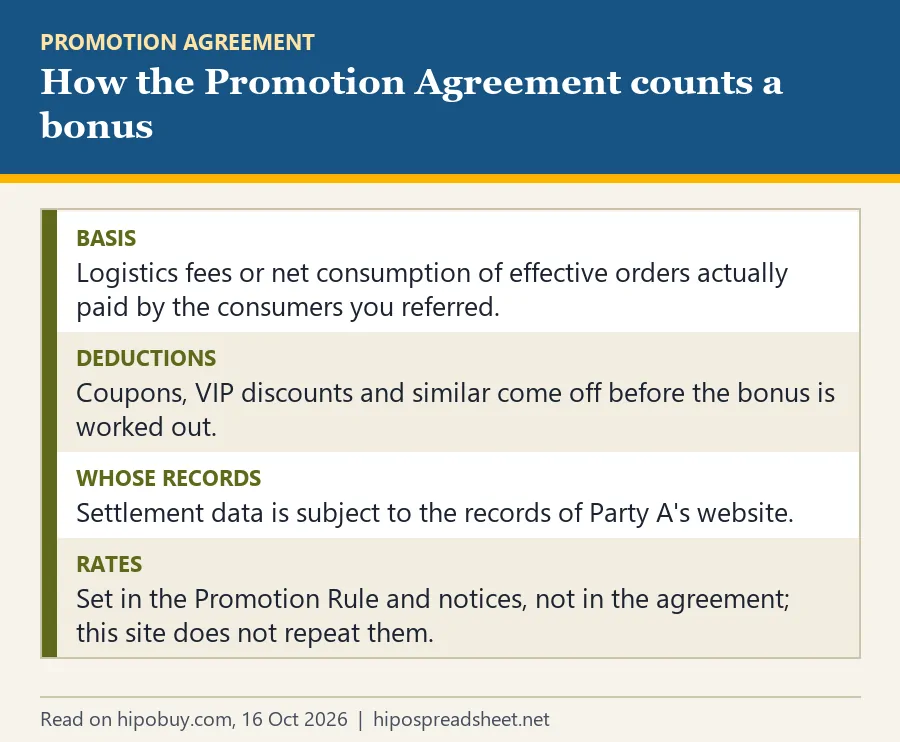
The bonus is a share of what the consumers you refer actually pay: logistics fees, or the net consumption of effective orders, after coupons, VIP discounts and similar deductions. The settlement data is whatever Party A’s website records. Party A may also deduct anything Party B owes under the agreement, such as liquidated damages, after notifying Party B. In short, the numbers that decide a bonus are Hipobuy’s numbers.
Tax on bonuses is withheld by Party A
A short paragraph deals with tax. Taxes due under the law, personal income tax included, are the partner’s to bear, and Hipobuy, as Party A, deducts them from bonuses before paying out. Party A can also suspend related payments until Party B corrects problems Party A finds during withholding.
The agreement does not say which country’s tax it means, or how withholding works for a partner outside China. If you take part, keep your own records of what you were paid and ask a tax adviser where you live how to declare it; the agreement does not do that for you.

How the arrangement can end
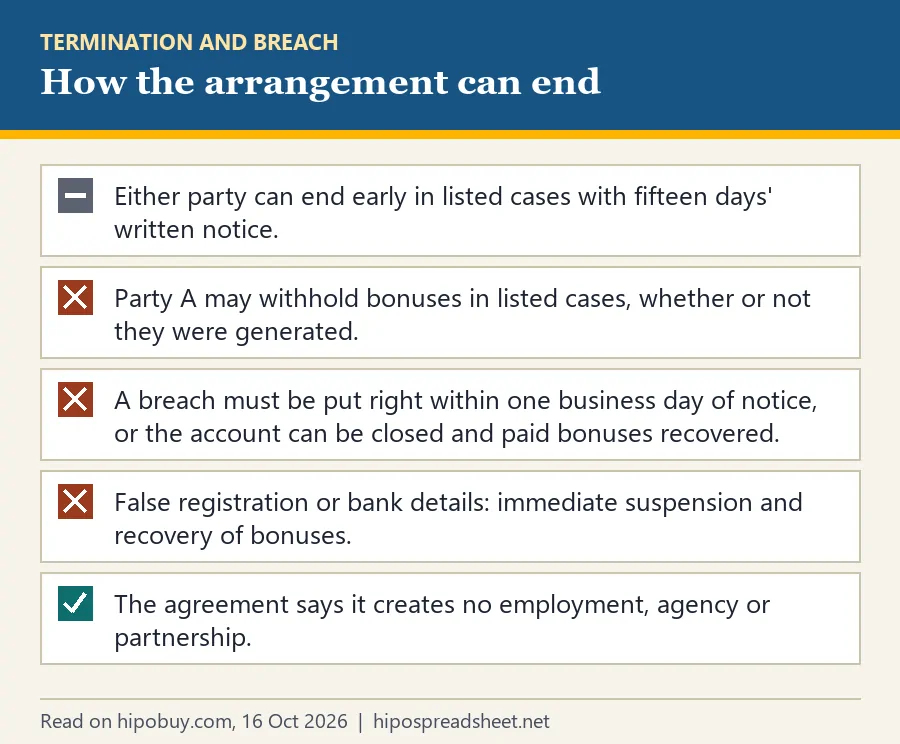
The agreement gives each side ways out. Party B may end it early, with fifteen days’ written notice, in listed cases on Party A’s side, such as Party A’s property being seized by a court so that bonuses cannot be paid. Party A may refuse to pay bonuses, generated or not, or end the agreement with the same notice in listed cases on Party B’s side.
Breach is handled fast. Party B must put a breach right within one business day of a written or email notice; if not, Party A may rescind the agreement, close the account and recover bonuses already paid. False registration, identity or bank details allow immediate suspension and recovery. The agreement also states that it creates no employment, agency or partnership between the parties.
Article 9: Chinese law and the Xiaoshan court
Article 9 closes the agreement. It is governed by the laws of the People’s Republic of China, and if negotiation fails, either party may sue in the people’s court in Xiaoshan District of Hangzhou, where Party A is located. That is a fourth forum on this site, next to the Yuhang court of the Registration Agreement, the Hong Kong SAR law of the Service Terms and the Hangzhou arbitration of the parcel agreement. The comparison is on law and forums.
