Submit Parcel: two reminder links and an arbitration clause in Hangzhou
Your goods are in the warehouse and photographed. Sending them is a second agreement, with its own documents, its own law and a different kind of forum from every other Hipobuy page.
The note above Submit Parcel
To ship, you select items on the Warehouse page, create a parcel, add an address, choose packaging and a shipping line, optionally switch on Purchase Protection, apply a coupon and pay. The final row of the parcel page, in Hipobuy’s tutorial image from August 2025, holds a short note with a ticked circle: Please be aware of the risks before clicking submit, then two underlined links, Tax Reminder and Logistics Reminder, and the Submit Parcel button.
Hipobuy’s page tags match the links: the parcel submit page (CFG_PAGE_SUBMIT_EXPRESS) and the parcel payment page (CFG_PAGE_PAY_EXPRESS) both carry the International Parcel Delivery Agreement and the Tax Warning. The same tutorial image shows one more term printed straight on the page rather than in a document: once a parcel has been packed, the packaging materials fee is non-refundable and a ¥10.00 operational fee per parcel applies to a cancellation, unless the platform caused it.

Arbitration in Hangzhou, and the Chinese text prevails
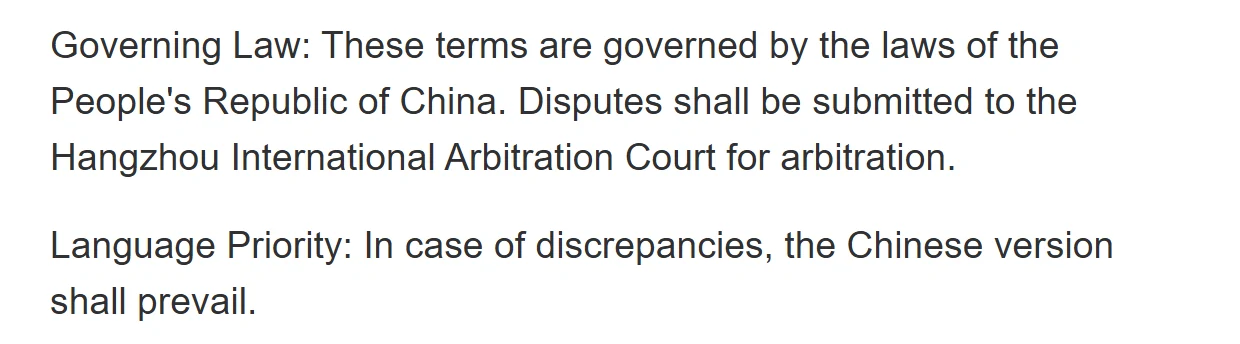
The International Parcel Delivery Agreement, notice 1772881180494462977, is short: about a dozen paragraphs. Its last clauses are the ones that make it unusual. PRC law governs the terms, and a dispute ends up in arbitration before the Hangzhou International Arbitration Court rather than in a court. Every other Hipobuy document with a forum clause names a court.
The next line sets a language rule: in case of discrepancies, the Chinese version prevails. No Chinese version is linked from the English page we read, so an English reader agrees to a text that the agreement itself ranks second. The agreement closes with a confirmation in the first person, saying you have read and understood the acknowledgment and agree to abide by it, which is what the ticked note above Submit Parcel stands in for.
The declared value is the basis for a loss claim
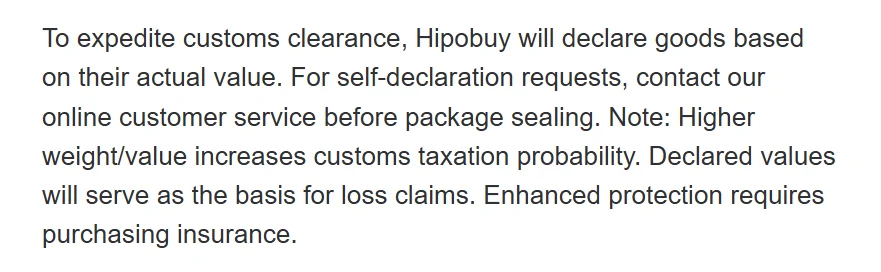
One paragraph of the agreement deals with the customs declaration. Hipobuy says it declares goods at their actual value to speed up clearance; if you want to make your own declaration, you contact online customer service before the parcel is sealed. The paragraph then ties the declaration to claims: declared values serve as the basis for loss claims, and enhanced protection requires buying insurance.
We quote this for one reason: the agreement connects declared value to loss claims; it does not, in this paragraph, set out a complete payout calculation. We do not give declaration advice. The rules for what you must declare are set by the destination country, and a wrong declaration is your responsibility under the same agreement, which asks you to indemnify Hipobuy for losses from false declarations.
The Tax Warning, in full
Behind the Tax Reminder link is the whole Tax Warning, notice 1772880991700451330, quoted here in full because it is short: there will have risk of parcel being taxed during the customs clearance; if you receive a tax notice, please clear the customs and pay the taxes, or an expensive fee of parcel return might incur. The grammar is Hipobuy’s.
It names no law and sets no amount. The fuller version is the Customs and Taxation article in the help centre, which adds that some customs risks, such as returns, fines and taxes, “will be borne by you”. Taxes depend on your country’s rules on the day the parcel arrives, not on anything Hipobuy prints, so check your own customs authority’s pages before a large parcel.

The Purchase Protection switch has no linked document
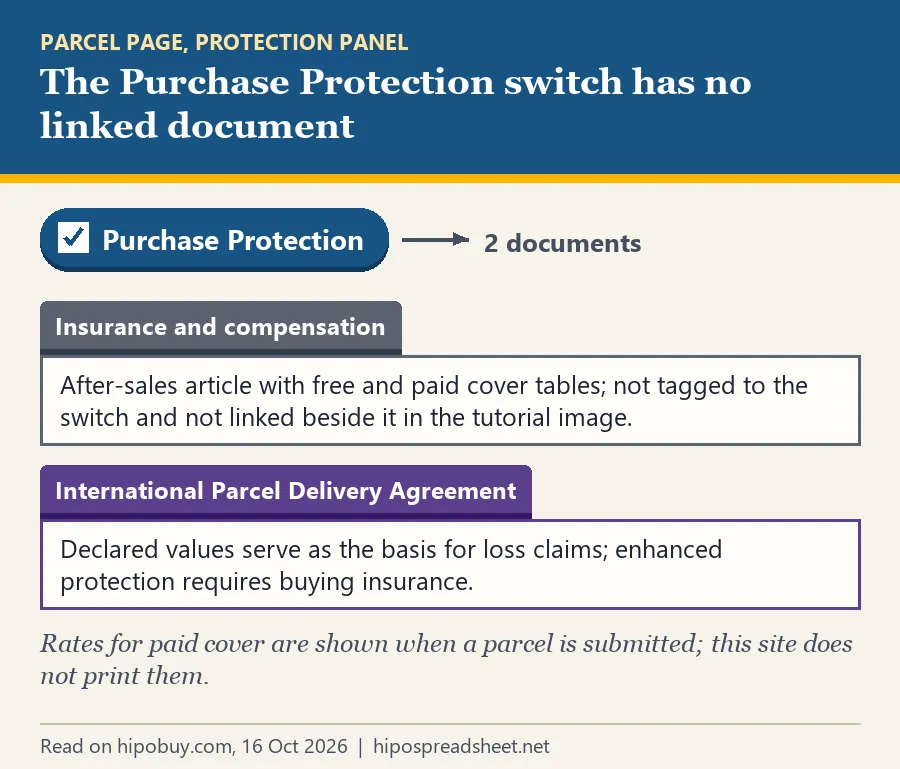
Higher up the same parcel page is a switch labelled Purchase Protection, with two kinds of cover listed under it, loss or damage protection and customs seizure protection. In the tutorial image there is no document link beside the switch, and Hipobuy’s data tags no article to it. The rules live in an after-sales article, Insurance and compensation, notice 1906603612122468353, which you would have to find yourself.
That article describes a free default cover and paid cover, with tables of what each pays; the paid rate is shown when you submit a parcel, and this site does not print it. The detailed comparison of what each cover pays belongs to sites that study cover; for this map the point is simpler: switching on protection is the one choice on the parcel page that comes with no linked terms at all.
Shipping lines and customs: what the agreement covers
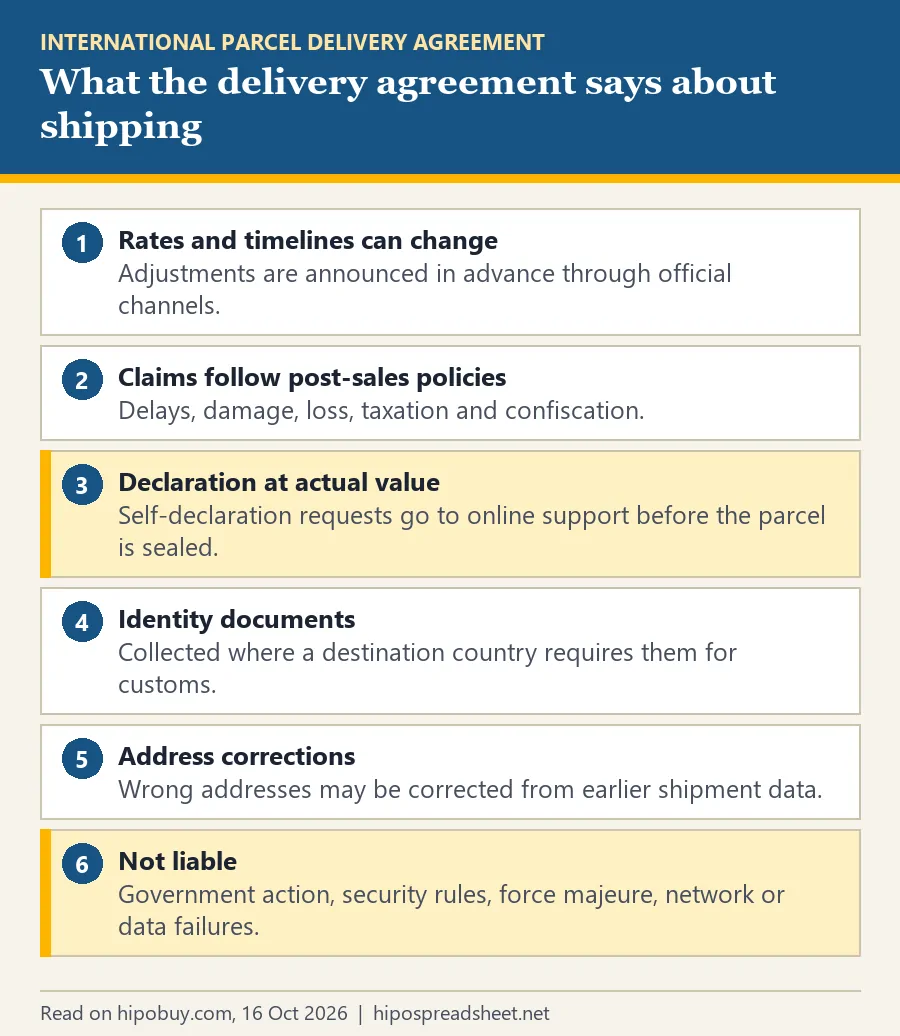
The delivery agreement says little about the shipping line you pick, but we record what it says without determining enforceability in an individual dispute. Hipobuy may adjust rates and timelines with operating costs and the market, announcing changes in advance through official channels. Delays, damage, loss, taxation and confiscation are handled under its post-sales compensation policies. Identity documents are collected where a destination country requires them for customs, and a wrong address may be corrected from your earlier shipment data.
It also lists four causes Hipobuy is not liable for: acts of authorities or third parties, government security rules, force majeure such as strikes or system failures, and network or data failures. Customs rules themselves are left to you; the Customs and Taxation article says heavy or valuable parcels are more likely to be inspected. The line names, prices and delivery windows you see in the shipping estimator are live data that changes often, which is why this map does not reprint them.
Read the agreement against the parcel you are sending
Before the second payment, check the actual list of items, address, packed size and weight, chosen route and selected extras. Your earlier product payment covered a different stage. International freight, conversion or payment costs, packing and applicable destination charges still need to be understood. If an amount is a deposit, retain the basis of the estimate and the final adjustment.
Combining purchases can avoid repeated parcel charges, but a single restricted product or large box can change the available services. Compare the proposed combined parcel with a split shipment when the difference matters. Keep a copy of the conditions and selections at submission, especially the treatment of loss, damage and exclusions. A checked box records a choice; it does not prove every possible incident is covered.
Forwarding orders bring their own disclaimer
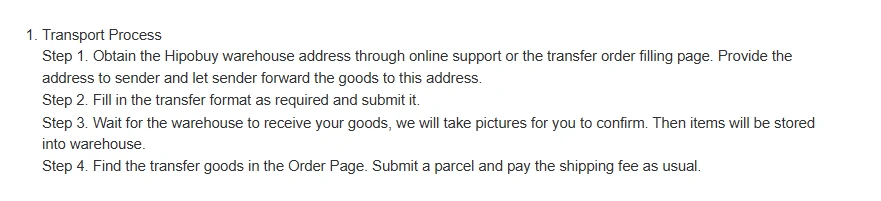
A forwarding order, where you send goods you bought yourself to Hipobuy’s warehouse, has its own disclaimer, tagged to the transfer order page (CFG_PAGE_SUBMIT_TRANSFER). It gives four steps: get the warehouse address from support or the order form, fill in the transfer order, wait for photos when the goods arrive, then submit a parcel and pay shipping as usual.
When that parcel ships, you meet the same two reminder links as any other parcel. The disclaimer itself adds one rule worth knowing before you start: Hipobuy provides no after-sales service for forwarded goods. A longer Parcel Forwarding Services Agreement also exists in the help centre, with no page tag and no law clause.